

Arabic perfumes for everyday life: 7 scents for every day
Table of Contents
- What makes Arabic perfumes so special for everyday life
- The most important ingredients: Oud, Musk, and Amber in everyday life
- Arabic perfume longevity: What you can really expect
- Oriental scents for the office: Dosage and etiquette
- Arabic perfume samples: How to test risk-free
- Price-performance ratio: What oriental scents cost in everyday life
- Conclusion: How to find your Arabic everyday scent
- Frequently Asked Questions
Last updated: September 17, 2026
What makes Arabic perfumes so special for everyday life
Arabic perfumes for everyday life are fragrance compositions from oriental perfumery that impress with a high fragrance oil content, complex fragrance pyramids, and long-lasting durability. These very qualities make them a practical alternative for many people to Western designer fragrances, which often fade more quickly.
The decisive difference lies in the concentration. While classic Eau de Toilettes rely on a low fragrance oil content, oriental scents often use significantly more fragrance oil. The result: fewer sprays, longer durability, and a more intense fragrance character. Those who test the selection of 3 ml samples at LuxusAroma usually notice this difference after just a few hours. That is precisely why it is worth looking at the concentration before deciding on a bottle.
Fragrance oil content and concentration: Why oriental scents last longer
A higher fragrance oil content does not automatically mean that a scent feels heavier. Initially, it only means that the fragrance concentration is higher and the base notes evaporate more slowly. In practice, this means: A single spray in the morning can last until the evening, whereas a light Eau de Toilette needs to be reapplied after two to three hours.
For everyday life, this is an advantage. You save time, save product, and have to spray less often. The European Commission's consumer information on fragrances in cosmetics explains that fragrances are among the most common contact allergens in cosmetics, which is why dosage and tolerance on your own skin are more important than pure intensity.
The most important ingredients: Oud, Musk, and Amber in everyday life
Oud, Musk, and Amber are the three basic building blocks that characterize oriental scents. Oud stands for woody-smoky depth, Musk for a soft, warm base, and Amber for a resinous-sweet arch over everything. Together, they create what many describe as typically oriental.
Oud is a resin from the wood of the agarwood tree. Musk is now produced almost exclusively synthetically. Amber, in turn, is a fragrance note that provides warmth and longevity. Crucial for everyday life: A fragrance with a high Oud content can easily feel heavy, while Musk and Amber round out the scent without overwhelming it. If you don't know your fragrance family yet, you should start with a sample that contains all three notes.
| Ingredient | Fragrance Character | Everyday Suitability |
|---|---|---|
| Oud | Woody, smoky, intense | Evenings, cool days |
| Musk | Soft, warm, skin-like | Office, all-day |
| Amber | Resinous, sweet, warm | Autumn, winter |
Arabic perfume longevity: What you can really expect
The longevity of Arabic perfumes cannot be described with a single number. It depends on three factors that work together: fragrance oil concentration, the fragrance family, and the application point. Anyone who knows these three factors can estimate the longevity of a fragrance quite well before purchasing.
Concentration as the first lever. Oriental scents are predominantly offered as Eau de Parfum or as perfume oil (Attar). An Eau de Parfum typically falls in the range of about 15 to 20 percent fragrance oil, while a pure perfume oil can be higher. A classic Eau de Toilette, on the other hand, is often in the range of 5 to 15 percent. These differences explain why scents with a similar fragrance character stay on the skin for different lengths of time.
Fragrance family as the second lever. Heavy base notes like Oud, Amber, Musk, Sandalwood, and Patchouli evaporate slowly and last accordingly long. Light top notes like citrus, bergamot, or fresh flowers, on the other hand, disappear within the first one to two hours. An Arabic everyday scent with a high Oud or Amber content therefore usually lasts noticeably longer on the skin than a citrusy one.
Application point as the third lever. On clothing, a scent lasts significantly longer than on the skin because textiles release fragrance molecules more slowly.
Skin chemistry: Why the same scent works differently on every skin
Skin chemistry determines how a scent unfolds. Oily skin holds fragrance molecules longer, dry skin releases them faster. The pH value and body temperature also play a role. That is why the same scent rarely smells identical on two people, and that is why testing on your own skin cannot be replaced by anything else.
Seasonal adjustment: Which scent fits which season
In summer, heavy Oud compositions quickly feel overwhelming. Light, floral, or citrusy oriental scents fit better. In winter, spicy, resinous, and woody profiles that only come into their own in the cold are appropriate. A good everyday scent therefore cannot be recommended across the board but follows the season.
Sillage and projection: How much scent cloud is suitable for everyday use?
Sillage describes the scent trail a person leaves behind while walking; projection refers to how far the scent radiates from the body. Both values are closely linked to the concentration. A fragrance with a high fragrance oil content and heavy base notes generally has a larger sillage than a light one.
Care tips: How to make your scent last longer
Perfume is a delicate product. Direct sunlight, extreme temperature fluctuations, and heat accelerate the decomposition of fragrance molecules. A cool, dark place, such as a cupboard or a drawer, is better suited for storage than a bathroom shelf above the radiator.
Oriental scents for the office: Dosage and etiquette
Oriental scents for the office work when dosed sparingly. One to two sprays on skin or clothing are completely sufficient with high fragrance concentration. Anything beyond that is quickly perceived as intrusive in an enclosed space.
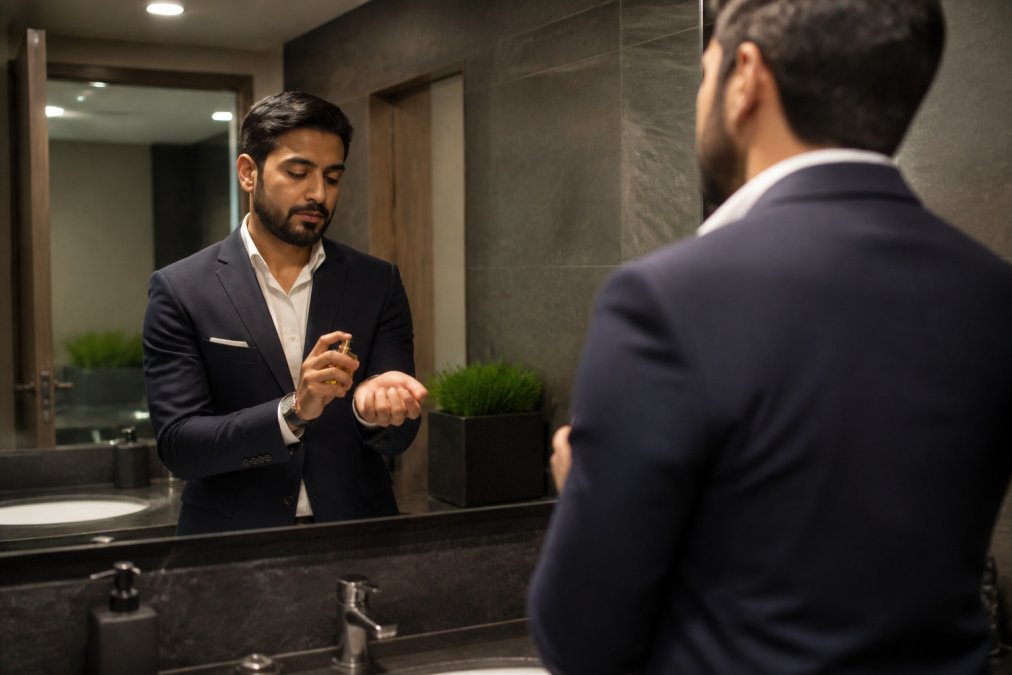
Office etiquette follows three simple rules:
- Apply before entering the office, not at your desk.
- Choose musk or amber-based scents instead of heavy Oud profiles.
- If in doubt, ask a trusted colleague for honest feedback.
Layering guide for beginners: How to combine oriental scents
Layering means wearing two scents on top of each other to create a unique fragrance character. For beginners: first the base, then the crown. Apply the heavier, amber or oud-based scent to the skin first, then the lighter, floral or citrusy scent on top. The base lasts longer, the crown provides freshness.
Arabic perfume samples: How to test risk-free
Arabic perfume samples are the cheapest way to really get to know a fragrance. A 3 ml sample is enough for several applications and shows how the fragrance develops throughout the day and on your own skin. This can never be fully judged by a store test.
How to proceed with testing:
- Wear the sample on a normal everyday basis, not for a specific occasion.
- Apply to skin and, if necessary, to a piece of clothing.
- Check the scent after one, four, and eight hours.
- Note whether the top, heart, and base notes suit you.
- Only decide on a bottle after two to three days of testing.
Price-performance ratio: What oriental scents cost in everyday life
The price-performance ratio of oriental scents depends less on the purchase price than on efficiency. A scent with a high fragrance oil content requires fewer sprays per day, lasts longer, and needs to be repurchased less frequently. Over the lifespan of a bottle, a higher initial purchase price is significantly relativized.
- Raw materials: Real Oud from agarwood is one of the most expensive raw materials in perfumery. Synthetic alternatives and modern molecules reduce the price considerably without necessarily worsening the fragrance character.
- Concentration: A perfume with a high fragrance oil content is more expensive to produce than a light Eau de Toilette.
- Bottle size and packaging: Larger quantities lower the price per milliliter, while elaborate packaging increases it.
How to recognize a good price-performance ratio
A good price-performance ratio is not shown on the label but in everyday life. A scent that is applied once in the morning and lasts until the evening provides a different value than a scent that disappears after two hours. Anyone who knows the fragrance concentration, the fragrance family, and their own skin chemistry can assess this question much better before purchasing.
Conclusion: How to find your Arabic everyday scent
The biggest hurdle is not the selection, but the uncertainty before the first purchase. Anyone looking for an Arabic fragrance for everyday use should start with a sample, test it on their own skin over several days, and only then invest in a full bottle. This way, you avoid bad purchases and find a scent that suits your everyday life.
Frequently Asked Questions
Which Arabic perfumes are best suited for the office?
For the office, oriental scents with a moderate fragrance oil content and a fresh to woody scent pyramid are suitable. Look for compositions where oud and amber only appear in the base note, while top and heart notes feature citrus, lavender, or light florals. Spray a maximum of two spritzes on your chest or neck, not on your wrists, as these are constantly near your head while typing. Test the fragrance beforehand with a 3ml sample over a full workday.
Are Arabic fragrances too intense for daily use?
Not necessarily. The intensity depends on the fragrance oil content and the dosage. Many oriental perfumes have a high fragrance concentration, which is why a single spray is often sufficient. For everyday use, choose compositions with a balanced scent development rather than pure "oud bombs." A fragrance that is strong in the first 30 minutes usually calms down in the heart note. Use 3ml samples to test how the scent develops on your skin over six to eight hours.
How do I correctly dose oriental perfumes for everyday life?
Start with one spray on the chest and wait 20 minutes before applying more. Scent development takes time: the top note fades, while the heart and base notes only begin to unfold. For the office, one to two sprays are sufficient. For the evening, you can increase it to three. Do not spray on clothing, as fragrance oils can stain fabrics and the longevity will be different there. If the fragrance intensity is high, applying it to a damp patch of skin helps.
How long do Arabic perfumes last on the skin?
Longevity varies depending on the fragrance oil content, skin type, and environment. Highly concentrated oriental perfumes with oud, amber, and musk can remain on the skin for eight to twelve hours, sometimes longer on clothing. Fragrances evaporate faster on dry skin. Applying moisturizer before application extends longevity. Test how the scent lasts on your skin throughout the day with a 3ml sample before buying a large bottle.

